

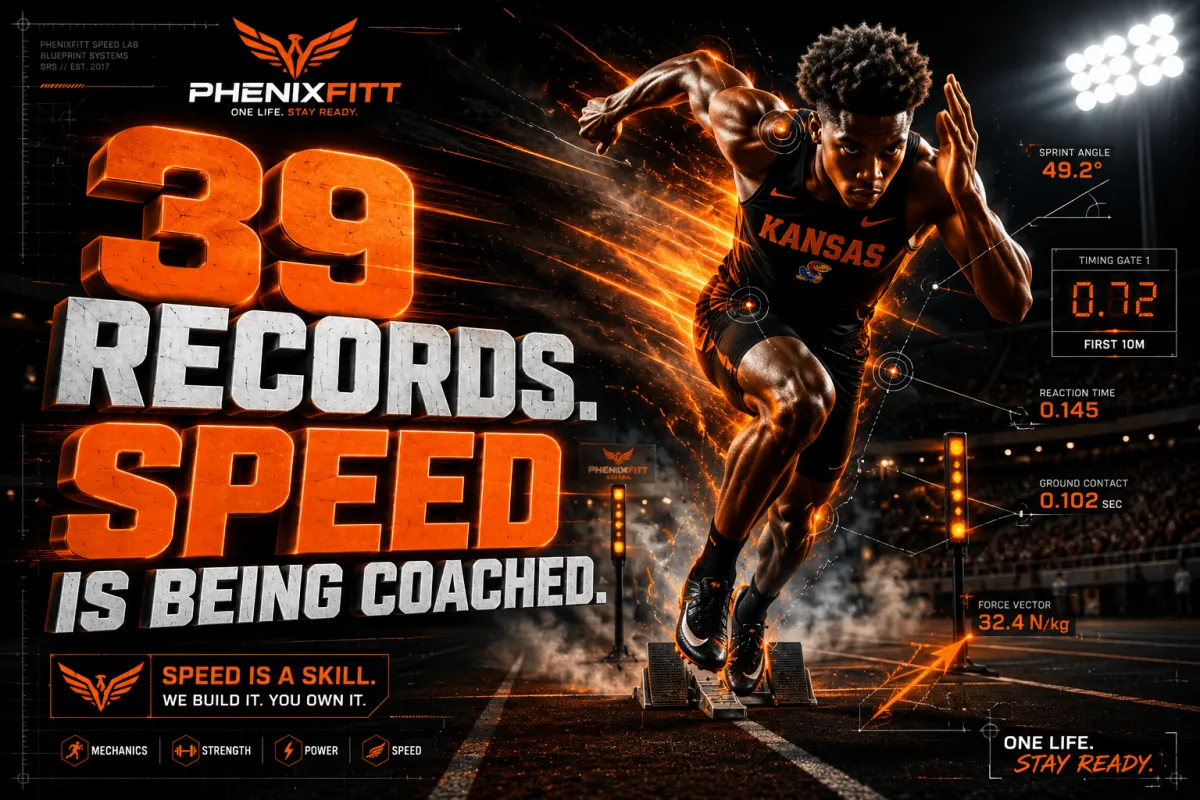
What Do 39 Kansas State Track Records Tell Us About Speed
The Quick Hit:
•Why did 39 state track records fall in one weekend — and what does it mean for your athlete?
•"Speed is not magic. Speed is mechanics, practice, feedback, and consistency."
•Can speed really be taught to middle school and high school athletes?
•One tenth of a second. One yard of separation. The math is real.
The Full Story:
The 2026 KSHSAA State Track & Field Championships gave parents, coaches, and athletes a loud reminder: speed is changing because coaching is changing. Sports in Kansas reported that the meet produced 39 state meet records in one weekend, not including wheelchair events. That number matters because records do not fall in bunches when athletes simply “get lucky.” They fall when preparation, mechanics, timing, strength, rhythm, and coaching meet the moment.
The championship took place May 29–30, 2026, at Wichita State’s Cessna Stadium, where KVOE reported that weather delays stretched Saturday’s competition deep into the night. Even with that disruption, performances kept rising. Catch It Kansas highlighted Ava Claasen’s 10:04.27 Class 5A girls 3200m state meet record, Daniel Enriquez’s 8:59.18 Class 5A boys 3200m state meet record, Shinji Pollard’s 13.88 Class 5A 110m hurdles preliminary record, and Ashley Lehman’s 54.02 Class 3A 400m preliminary record. KSN also reported that Lehman won the 100m, 200m, 400m, and pole vault, while Wellington’s Dru Zeka captured four crowns of her own.
The message for local families is clear. Your athlete does not need to be labeled “naturally fast” before they can improve. They need to be taught how to sprint. That is the purpose of Speed Workouts by PhenixFitt — Level 1, which starts with a FREE Assessment that includes baseline timing and running form analysis. Book it now at PhenixFittSpeed.com or call 833-308-1776.
Why Did 39 State Meet Records Fall In One Weekend?
Records fall when athletes arrive prepared. Kansas did not produce one isolated breakthrough. It produced a wave. Sports in Kansas counted 39 state meet records, while local coverage documented record-level performances across distance events, hurdles, sprints, jumps, vaults, and throws.
That spread says something important about youth development: more athletes are getting specific training, better feedback, and performance coaching earlier.
The sprint-related examples matter for athletes in every sport. Pollard’s hurdle record required rhythm, posture, takeoff distance, clearance, and re-acceleration. Lehman’s 400m record-level performance required speed endurance built on efficiency. KVOE also reported Kyson Proffitt of Jackson Heights winning the Class 2A boys 100m in a state-record 10.75 seconds. These are not just effort stories. They are mechanics stories.
“To a sprinter, the hundred-yard dash is over in three seconds, not nine or ten.” — Jesse Owens
Owens understood what many young athletes are never taught: sprinting has phases. The start matters. The first strides matter. The transition matters. The finish matters. If the race is decided before most people understand what happened, then sprinting must be taught with precision. PhenixFitt treats speed like a skill, not a gift.
Can Speed Really Be Taught To Middle School And High School Athletes?
Yes. Speed can be taught because sprinting is a motor skill. Nobody would tell a young basketball player that shooting form cannot improve. Nobody would tell a quarterback that throwing mechanics do not matter. Yet too many athletes are told to “get faster” without being taught how speed works.
Acceleration has teachable positions. The first steps have teachable angles. Arm action has rhythm. Foot strike has timing. Posture, relaxation, shin angle, knee drive, hip projection, and force direction can all be coached. When those pieces improve, the athlete wastes less motion and applies force more effectively.
“I overcame size with mechanics.” — Edwin Moses
That quote belongs in every youth performance conversation. A middle school athlete may not be the biggest yet. A high school athlete may not have hit full physical maturity yet. But both can learn to move better, accelerate cleaner, and sprint with more purpose. Speed Workouts by PhenixFitt — Level 1 teaches sprint mechanics, running form, and drills for middle school and high school athletes across all sports. The first step is a FREE Assessment, because development should begin with truth, not guessing.

What Does The FREE Assessment Reveal Before Training Begins?
The FREE Assessment reveals where the athlete is starting. A baseline time tells the athlete and coach what the clock says right now. Running form analysis shows how the athlete creates speed, where they leak energy, and what technical changes can make the biggest difference.
For some athletes, the issue is posture. They pop up too early and lose acceleration. For others, it is arm action. The arms cross the body, shorten the stride, or disrupt rhythm. Some athletes reach with the foot, strike too far in front, or spend too long on the ground. A good assessment separates effort from efficiency.
That is why PhenixFitt Level 1 starts by measuring. The athlete does not just receive a stopwatch number. They receive a starting point. From there, the program teaches sprint mechanics, form, drills, and the movement foundation needed to improve. The process is simple: measure, teach, train, correct, repeat. If your athlete has never had sprint mechanics evaluated, book the FREE Assessment now at PhenixFittSpeed.com or call 833-308-1776.
Why Do Sprint Mechanics Matter In Every Sport, Not Just Track?
Track makes speed obvious because the clock is public. But every sport has a hidden clock. In football, it is the first step off the line, the closing angle, the route break, and the recovery sprint. In basketball, it is the closeout, transition lane, backdoor cut, and first-step drive. In soccer, it is the separation run and race to the ball. In baseball and softball, it is the jump out of the box, the steal, and the first three steps in the field.
That is why the Kansas records matter beyond track. They show a public version of a private truth: when athletes learn to move better, performance changes. The clock records it in track, but the scoreboard sees it in every sport. Speed helps an athlete arrive earlier, separate cleaner, recover faster, and make plays that slower movement cannot reach.
“One step at a time. One round at a time. Know your why.” — Allyson Felix
The best athletes build speed through repeated, intentional steps. They know what they are training and why. That mindset is exactly what young athletes need. Speed development is not punishment conditioning. It is skill acquisition under coaching.

Is Your Athlete Being Told To Get Faster Or Being Taught How To Sprint?
There is a difference between being told to get faster and being taught how to sprint. One is pressure. The other is development. One creates frustration. The other creates a plan. If a coach says, “run harder,” the athlete may give more effort but still repeat the same inefficient movement. If a coach teaches posture, arm drive, ground contact, acceleration angles, and rhythm, the athlete has something specific to improve.
That is the PhenixFitt message. Speed is not magic. Speed is mechanics, practice, feedback, and consistency. The 2026 Kansas state meet made that message visible by producing record after record in one weekend. Local athletes do not need to watch that wave from a distance. They can begin the same kind of development with Speed Workouts by PhenixFitt — Level 1.
Start with the FREE Assessment. Get the baseline time. Get the running form analysis. Learn what your athlete is doing well, what needs correction, and how Level 1 can teach the sprint mechanics, form, and drills that create real speed development.
Do not wait until the next season exposes the gap.
PhenixFittSpeed.com | 833-308-1776 | FREE Assessment
One Life. Stay Ready. — C. Ray

