
Your Body Already Has the Answer: What Stanford's 'Natural Ozempic' Means for You
Yesterday morning, a woman came into the shop and couldn't get out of her chair. Not because of surgery, not because of an injury, not because of anything she could point to on a scan or explain to a doctor. She just couldn't get up on her own.
I walked over and we did a cross-grip — my right hand to her right hand, crossed like an X — and I pulled her to standing and held her there until she found her footing. Erica started talking to her, asking what was going on, and the story that came out was straightforward. She stays home now. Doesn't do much of anything physical. And somewhere along the way she made a quiet arrangement with herself: if it ever gets bad enough — if she reaches a point where she really can't get up — she'll call rescue. That's the plan. She said it without alarm, without embarrassment, without any particular weight to it at all.
No injury caused this. Nothing happened to her. She just stopped moving, and her body followed her lead.
She's seven years older than me. Seven.
She's not alone in this. Not by a long shot.
I've known him for a while — good man, used to train with us, drifted away the way people do when life gets busy and the easier thing starts winning. I understand that. What's harder to watch is what comes after. Every time I see him, there's a little more of him. Not dramatically, not all at once — just incrementally, the way these things always go. A little more belly, a little less movement, a little heavier every time, like someone has been quietly adding weight to a scale when nobody's looking.
He signed up with us last month. I was genuinely glad to see it. This morning he called to cancel. Said it's just not for him.
Now — our program is built to meet you exactly where you are. Hard if you want it hard, manageable if you need to start there. In person or online, anytime, day or night. Two days of mobility work you could do from your living room. The load adjusts to what your body actually needs — that's the whole point of the normal load post. There's almost no excuse this program doesn't account for.
But he has one thing he loves. Golf. He's protecting his time for that.
Here's what he doesn't see yet: he can't really walk the course anymore. The game he chose over his health — the one thing he decided was worth protecting — is already leaving him, quietly, in the same incremental way everything else has been going. He just hasn't said it out loud yet.
Two people. Different situations, different details — but the same story underneath. No diagnosis forced their hand. No accident took the choice away from them. This happened the slow, quiet, daily way these things always happen — one small surrender at a time.
And then Stanford published something that stopped me cold.
Because it told me exactly what both of them gave away — and why getting it back is still possible.
If they're willing to earn it.

The body that earns it keeps it. No shortcuts at sunrise.
Natural GLP-1 Is Real — The Problem Is You’ve Trained It Out
Stanford Discovers Natural Ozempic. Scientists Find Body's Own GLP-1 Molecule. New Research Could Replace Weight Loss Drugs.
People are reading those headlines the wrong way.
They're reading them like it's the announcement of a new pill. A better injection. Another version of the shortcut they've been looking for.
That's not what this is.
Stanford researchers recently identified a molecule called BRP — a naturally occurring peptide that mimics what GLP-1 drugs like Ozempic and Wegovy do in the body. It signals the brain to suppress appetite, regulate metabolism, and promote fat utilization.
Here's the part people miss:
Your body already produces it.
And it produces it in response to two things: exercise and fasting.
Not a prescription. Not a co-pay. Not a list of side effects. Movement. Strain. Discipline.
Your body was engineered for this. It's been waiting for you to ask it to work.
We must all suffer from one of two pains: the pain of discipline or the pain of regret.
— Jim Rohn
Stanford Found Something — But It's Not a Drug
Let's be clear about what happened here.
Stanford scientists weren't trying to build a better Ozempic. They were studying what happens inside the body during exercise and fasting — and they found BRP, a molecule that activates the same biological pathway that GLP-1 drugs hijack.
That's the word that should stop you.
Hijack.
GLP-1 receptor agonists — Ozempic, Wegovy, Mounjaro — they work by attaching to receptors in your brain and gut that were designed to respond to signals your body sends naturally. The drugs borrow the key. They unlock the door. And then they stay at the door indefinitely, holding it open, while your body forgets how to knock.
BRP is your body's own key.
When you train hard, when you fast, when you push — your body produces BRP as part of a natural hormonal response. It talks to your brain. It regulates hunger. It keeps your metabolism honest.
Stanford didn't discover a new drug.
They confirmed that what your body does on its own — when you actually work it — is the real medicine.

One is borrowed. The other is earned.
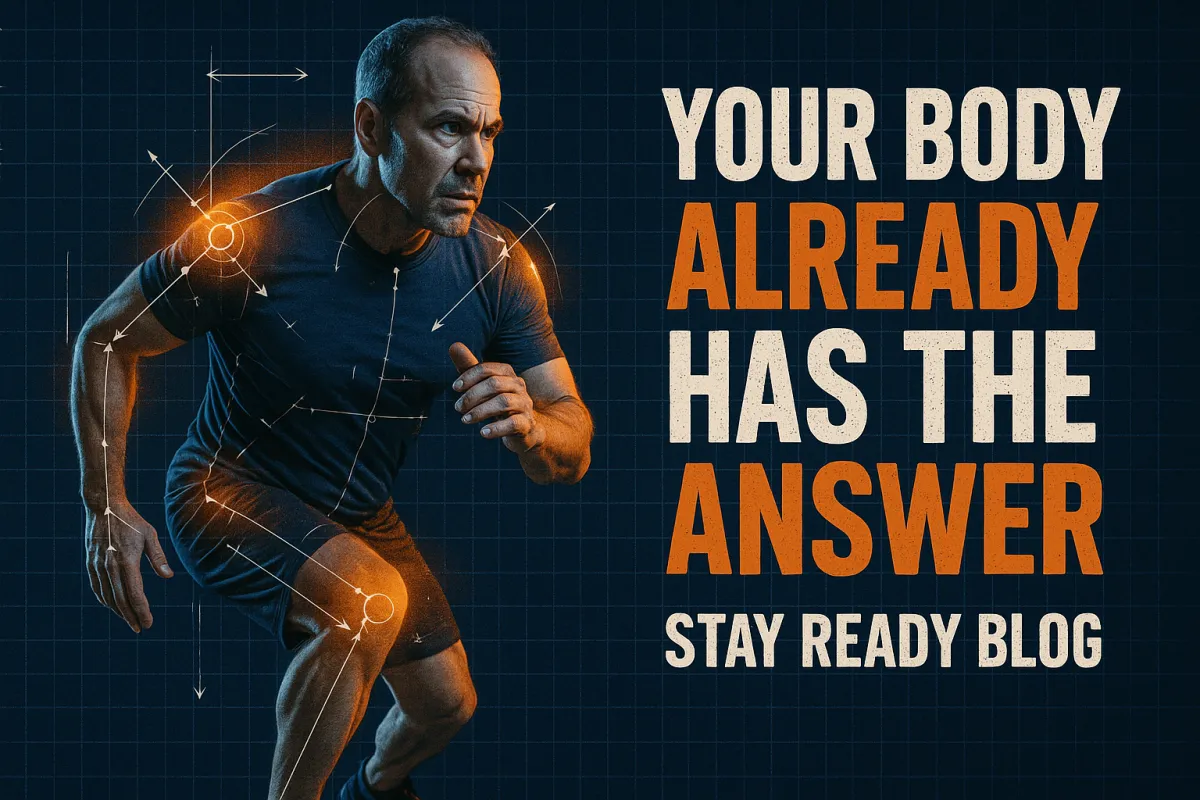
Your Body Already Has the Answer
This is the part that should fire you up.
The pharmaceutical industry has built a $50 billion market around something your body does for free.
When you lift. When you sprint. When you fast with intention. When you push through a hard week of training instead of sitting it out — your body responds. It produces hormones, peptides, and molecules like BRP that regulate your hunger, sharpen your metabolism, and tell your fat cells to get moving.
You've been sitting on a pharmacy this whole time.
The problem isn't your biology. Your biology is brilliant. It's been honed over thousands of years to respond to challenge — to movement, to periods of rest and periods of real demand. Every system in your body is waiting to be activated by the right stimulus.
The question isn't whether your body can do this.
The question is whether you're giving it what it needs to do it.
The Problem Isn't Your Biology — It's Your Behavior
Let's have an honest conversation.
Ozempic works. Let's not pretend it doesn't. For people in genuine medical crisis — morbid obesity, advanced diabetes, cases where the weight itself is the emergency — GLP-1 drugs have produced results that saved real lives.
That's not the conversation.
The conversation is about the millions of people using these drugs not because they're in a medical crisis, but because they want a faster, easier path to a body they haven't earned yet. And they're being handed that path without being told what they're giving up.
When your body stops having to produce its own metabolic signals — because a drug is doing it artificially — those systems go quiet. They downregulate. They forget how to work. You lose muscle. Your metabolism adapts to the suppression. And when you stop the drug, the weight returns — because nothing changed about the life that built it.
In the bricklayers post, we talked about the body needing strain to grow. That the body which never carries a heavy load becomes a body that can't. Same principle applies here.
The body that never has to regulate its own hunger — that never earns the hormonal reward of a hard training session or a clean fast — loses that capability over time.
You cannot outsource what was designed to be done from the inside.
Ease is a greater threat to progress than hardship.
— Denzel Washington
What Natural Ozempic Actually Looks Like in Practice
So what do you do with this?
You move. You train. You eat with intention. You fast when it makes sense for your body and your life.
This isn't about perfection. It's not about becoming an elite athlete by next Monday. It's about understanding that every session you commit to, every heavy training day you show up for, every time you choose the harder thing — your body is rewarding you in ways you can't always see on the surface.
BRP isn't the only molecule in play. When you train, your body releases a full cascade of responses. BDNF for brain function. Growth hormone for repair. Cortisol regulation for stress. And yes — molecules that tell your brain to eat less, want less, and keep your metabolism sharp.
You are not broken. You are under-challenged.
The formula isn't complicated:
Resistance training — 3 to 4 sessions per week. Compound movements. Heavy enough to mean something.
Cardiovascular work — Walk, run, sprint. Something that elevates your heart rate and sustains it.
Intermittent fasting — Even a simple 16:8 window activates the same fasting-state hormonal response these drugs try to manufacture.
Real food — Not perfect food. Real food. Protein. Whole sources. Less processed, less packaged.
That's the prescription.
And it's free.

This is what the prescription can't replicate.
The Pill Won't Save You. The Work Might.
Here's the bottom line.
Stanford's BRP discovery isn't a pharmaceutical breakthrough. It's a confirmation of something that has been true since the first human walked, hunted, labored, and survived.
Your body is a miracle — and it was built to move.
The pill will not save you. The injection will not save you. The shortcut will not save you.
But the work? The consistent, unglamorous, show-up-when-you-don't-feel-like-it work?
That might.
It might be the thing that adds years to your life and life to your years. It might be the thing your kids remember — not that you looked for the easy road, but that you didn't take it. It might be the thing that proves to your own body that you still believe in it.
Stanford found BRP. But you already knew what it required.
You've always known.
The question has never been what works.
The question is whether you'll do it.
No, I strike a blow to my body and make it my slave so that I myself will not be disqualified for the prize.
— 1 Corinthians 9:27
Do the work.
Even when you don’t feel like it.
Especially then.
Go to: https://phenixfitt.com/ or call me.
One Life. Stay Ready. — C. Ray
📞 833-308-1776 | 🌐 phenixfitt.com
PhenixFitt — Where Fitness Meets Readiness
