
The Two Options: Why You Are Either Getting Better or Getting Worse
From Grandma’s Wisdom to Your Workout
There is a viral stand-up comedy bit going around right now by a comedian named Mike Goodwin. In the clip, he shares some old-school advice from his grandmother about why you should never stress.
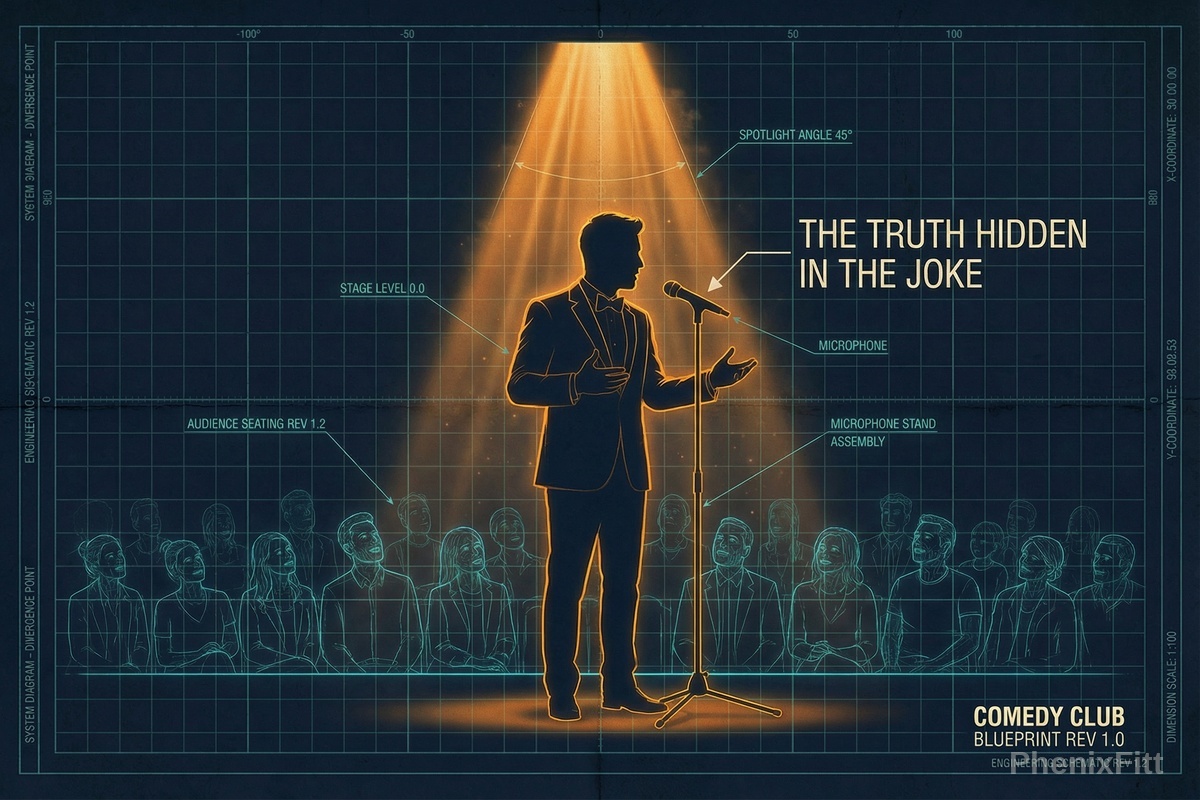
The joke goes like this: The Bible says there are only two things in life you have to worry about—whether you're healthy or whether you're sick. If you're healthy, you have nothing to worry about. But if you're sick, you have two things to worry about: whether you're going to get better or whether you're going to get worse.
He takes the joke all the way down the line—if you get worse, you have to worry about living or dying; if you die, heaven or hell; and if you go to hell, you have to worry about whether you'll be "original or extra crispy."
It is a brilliant, hilarious piece of comedy. I laughed out loud the first time I heard it. But underneath the punchline is a profound, binary truth about how we handle our physical health, especially after the age of 40.
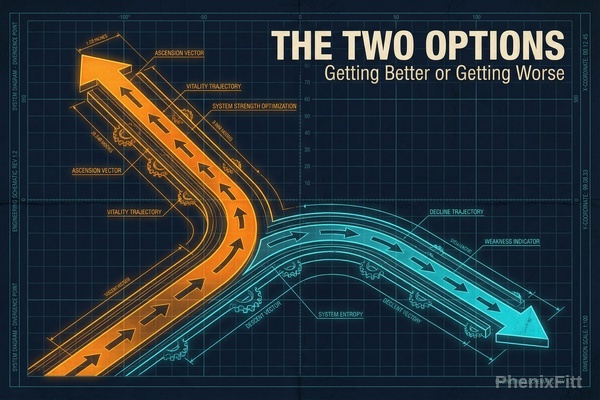
When it comes to your body, there really are only two options. You are either actively working to get better, or you are passively allowing yourself to get worse. There is no middle ground. There is no "coasting." You are either building the machine up, or the machine is breaking itself down.
The Myth of Coasting
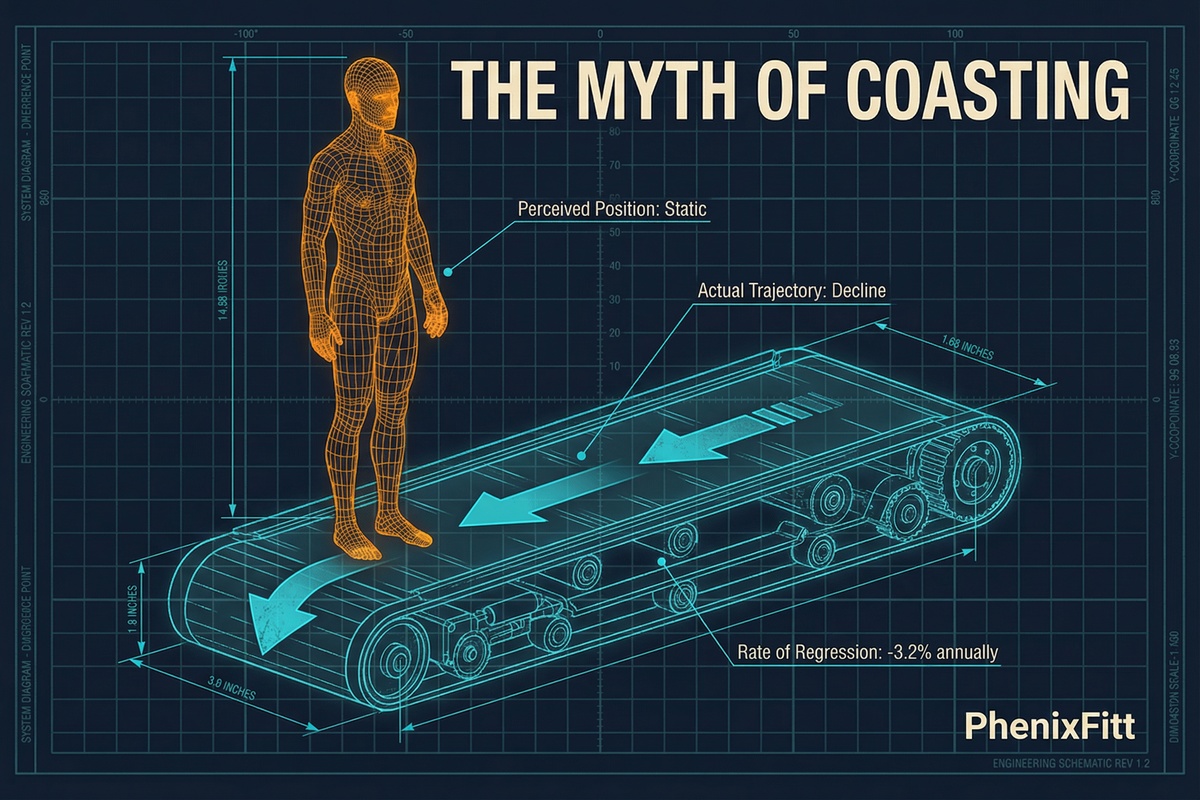
The biggest mistake people make in their 40s and 50s is believing that they can simply maintain their current level of health without putting in any extra effort. They assume that if they aren't actively gaining weight or suffering from a major illness, they are doing fine. They look in the mirror, see a version of themselves that looks roughly the same as it did five years ago, and think, "I'm holding steady."
But biology does not allow you to coast. Biology is a relentless, unforgiving accountant, and after the age of 35, it starts calling in debts you didn't even know you owed.
There is a condition called sarcopenia—age-related muscle loss—that begins to quietly steal your strength the moment you cross into your late 30s. It doesn't announce itself with a loud crash. It doesn't put you in the hospital. It just slowly, methodically chips away at your muscle mass. Year by year, your muscle fibers shrink, your metabolism slows down, and your joints become stiffer.
If you are not actively lifting weights, eating with intention, and fighting back against the aging process, you are getting worse. You might not feel it today, and you might not see it tomorrow, but the decline is happening. Every day you wait, the hill gets steeper. The muscle you lose today is harder to rebuild tomorrow. The joint stiffness you ignore this month becomes chronic pain next year.
Think of your body like a house. If you stop doing maintenance on a house, it doesn't just stay the same. The roof starts to leak, the foundation settles, the paint peels, and the pipes rust. Your body is the exact same way. If you aren't actively maintaining the structure, the structure is failing.
The Science of the Decline
Let's get into the weeds for a second, because understanding the science of what is happening to your body is the first step to stopping it.
Sarcopenia isn't just about looking less muscular in a t-shirt. It is a systemic breakdown of your body's functional capacity. Starting around age 30, you begin to lose anywhere from 3% to 5% of your muscle mass per decade. By the time you hit 50, that rate accelerates. By the time you hit 60, it's a full-blown landslide if you haven't put up any roadblocks.
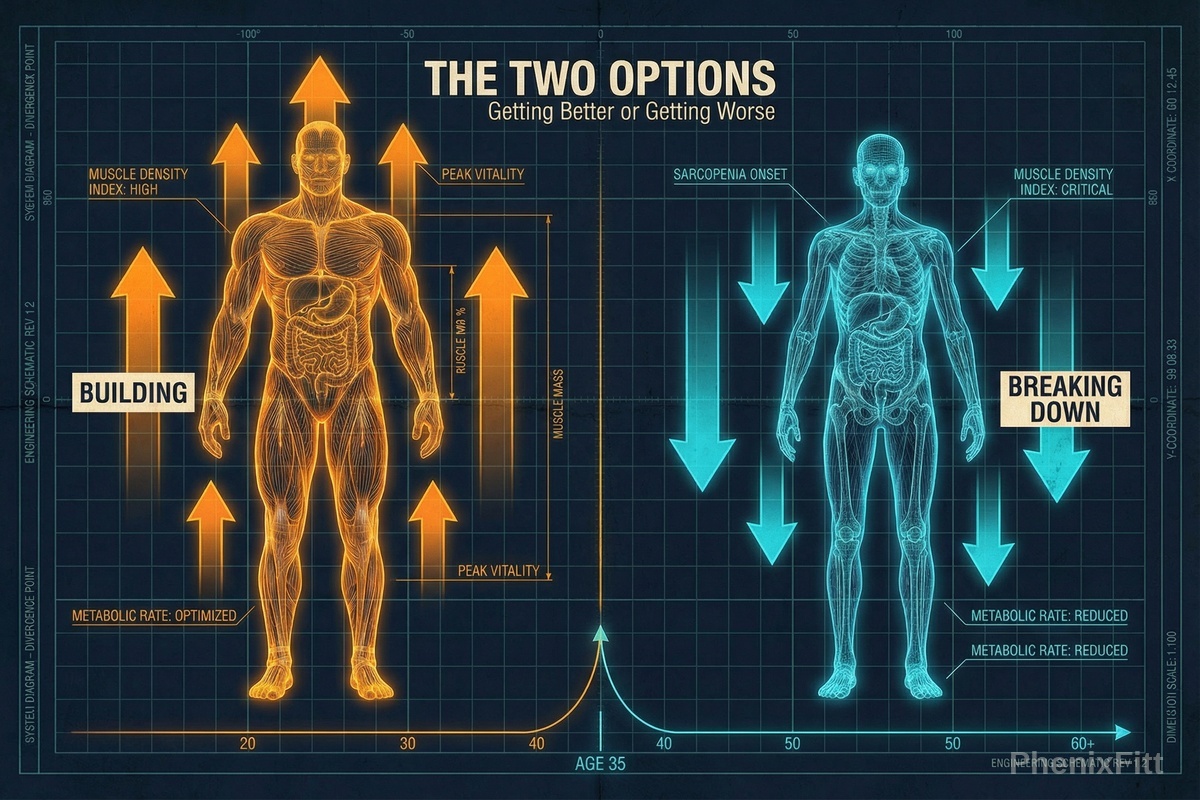
But it's not just the muscle you're losing. Muscle tissue is highly metabolically active. It burns calories just by existing. When you lose muscle, your basal metabolic rate drops. This is why so many people in their 40s suddenly find themselves gaining weight even though they haven't changed their diet. They are eating the same amount of food, but their engine has shrunk.
Furthermore, muscle acts as a shock absorber for your joints. When your leg muscles weaken, your knees take more of the impact when you walk or run. When your core and back muscles weaken, your spine takes the brunt of the load when you bend over to pick something up. This is why so many people over 40 suffer from chronic knee and lower back pain. It's not because their joints are inherently bad; it's because the muscular support system around those joints has eroded.
And then there is bone density. Muscle pulls on bone, and that mechanical stress signals the bone to grow denser and stronger. When you lose muscle mass and stop lifting heavy things, your bones stop receiving that signal. They become porous, brittle, and prone to fractures.
This is what "getting worse" looks like on a cellular level. It is a cascading failure of your body's systems, all triggered by a lack of physical resistance.
The Point of No Return
There is a concept I talk about often called the Point of No Return. It is that invisible line where the physical decline becomes so severe that reversing the damage feels nearly impossible.
If you spend your 40s passively allowing yourself to get worse, you will eventually hit that point. You will cross a line where the physical limitation is no longer a choice, but a permanent reality. You will wake up one day and realize that you can no longer hike the trail you used to love. You will realize that getting down on the floor to play with your kids or grandkids is a painful chore rather than a joy. You will realize that you have lost your physical independence.
And the tragedy of the Point of No Return is that it is entirely preventable. It is not a mandate from God. It is not an inevitable consequence of the calendar. It is the result of a thousand small choices to take the easy way out. It is the result of choosing the couch over the gym, the drive-thru over the kitchen, and the excuse over the effort.
You will look back wishing you had chosen the other option when you still had the chance. You will wish you had endured the temporary discomfort of a workout rather than the permanent discomfort of a failing body.
As Jim Rohn famously said, "Take care of your body. It's the only place you have to live." You are the only one responsible for keeping this machine moving forward. You are the only one who can decide to get better. No doctor, no pill, and no surgery can do the work for you. You have to pick up the weight. You have to push the sled. You have to make the choice.
The Beauty of Getting Better
But here is the good news—the incredible, empowering, life-changing news. The human body is remarkably resilient. It is a highly adaptive organism that responds to the demands you place on it.
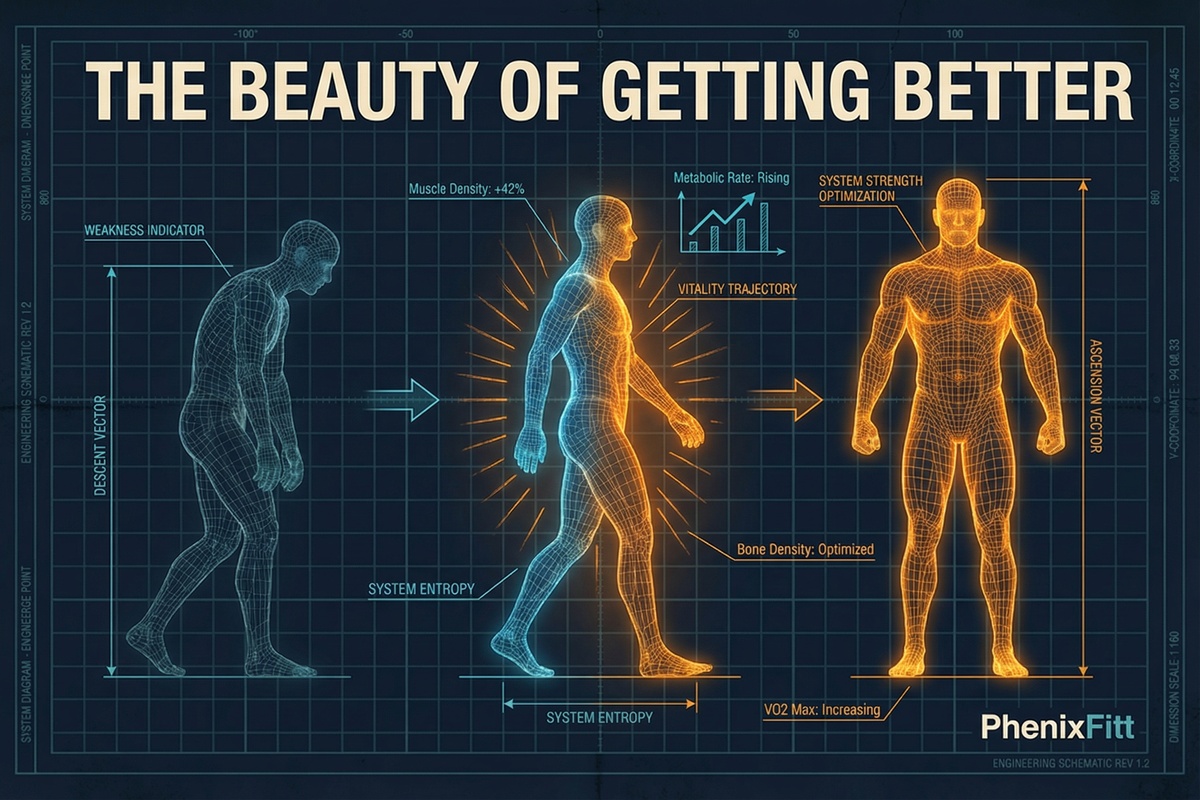
If you start placing demands on your body today, it will respond. It doesn't matter if you are 40, 50, or 60. If you start lifting weights, your body will build new muscle tissue. If you start eating enough protein, your body will repair the damage. If you start moving with intention, your joints will become lubricated and your bones will grow denser.
You can reverse the decline. You can push back the Point of No Return. You can choose to get better.
I have seen it happen a thousand times. I have seen men and women walk into PhenixFitt feeling broken, defeated, and resigned to their physical decline. They thought their best days were behind them. They thought the pain in their knees and the stiffness in their backs were just "part of getting older."
But then they started doing the work. They started lifting. They started sweating. They started choosing the voluntary pain of discipline over the involuntary pain of decline. And within months, they transformed. They didn't just look better; they moved better. They felt better. They reclaimed their independence and their confidence. They realized that they were not victims of their age, but masters of their biology.
That is the beauty of getting better. It is hard work, yes. It requires discipline, consistency, and a willingness to be uncomfortable. But the reward is a life lived on your own terms. The reward is the ability to say "yes" to the physical adventures of life without hesitation. The reward is knowing that you are strong enough to handle whatever terrain you find yourself on.
Stay Ready
At PhenixFitt, our entire philosophy is built around two words: Stay Ready.
Staying ready means you don't have to get ready when life demands something of you. It means having the strength, the mobility, and the resilience to handle the unexpected. It means recognizing that health is a binary choice, and actively choosing to get better every single day.
We don't train just to look good in a swimsuit, although that's a nice side effect. We train for life. We train so that when the heavy box needs to be lifted, we can lift it. We train so that when the long flight of stairs needs to be climbed, we can climb it. We train so that we are never a burden to the people we love.
Don't wait until you only have two things to worry about. Don't wait until you hit the Point of No Return. Take control of your health today. Choose to get better.
If you're ready to step up, embrace the discipline, and take control of your health, we are here to help you build the strength you need. We know the science, we know the methods, and we know how to get you from where you are to where you want to be. Visit us at phenixfitt.com to learn how our programs can help you rebuild your body and reclaim your life.
One Life. Stay Ready.— C. Ray
