
The Push-Up Doesn't Care
The Push-Up Doesn't Care: Why the Ultimate Exercise is the Great Equalizer
Mindset, Functional Athlete, PhenixFitt, Longevity
The reason I love push-ups is simple: you can't pay anyone to do them for you.
You have got to do them yourself. It does not matter how much money you have in the bank. It does not matter what color you are, what race, what sex, or what your background is. The push-up doesn't care. The only thing it cares about is getting the work done. And you can't cheat it. You either can do them, or you can't.
In a world obsessed with shortcuts, the push-up is brutally honest. It is the great equalizer.
A History of Resilience
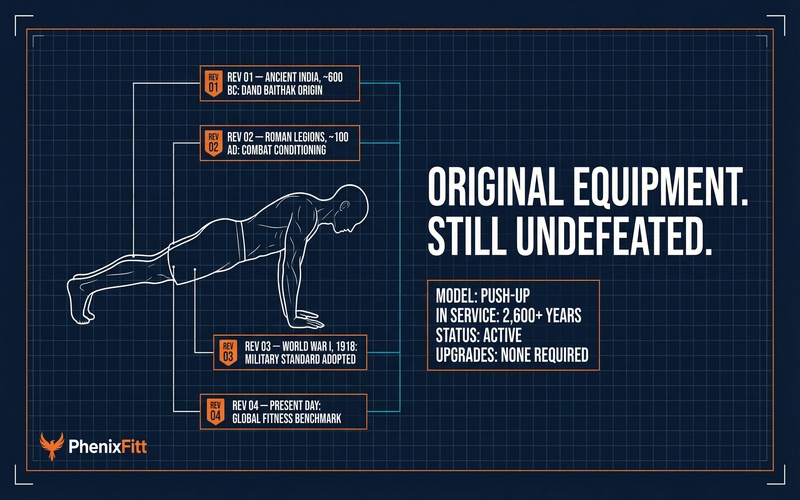
The push-up is not a new fad. It has been around for thousands of years. Ancient warriors in India used early variations of the push-up to build the strength and endurance required for battle [1]. Roman emperors and Greek soldiers relied on bodyweight calisthenics to stay in fighting shape [1].
Fast forward to the modern era, and the push-up remains the gold standard for military physical readiness. The United States Army uses the push-up as its primary measure of upper body strength, requiring recruits to tap into whole-body endurance to pass their fitness tests [1]. Why? Because the military knows that in a real-world scenario, you don't have a bench press or a set of dumbbells. You only have your body, and you need to be able to move it.
The Science of the Push-Up
The push-up is often thought of as just a chest exercise, but that is a massive understatement. When performed correctly, the push-up engages your body from top to bottom. It works your arms, chest, shoulders, abdomen, hips, and legs all at once [2]. It is a true full-body movement.
But the benefits go far beyond muscle. A landmark 2019 study published in JAMA Network Open followed a group of active men over a 10-year period. The researchers found that those who could complete at least 40 push-ups in a single clip had a significantly lower risk of heart attack, heart failure, or other cardiovascular problems compared to those who could complete fewer than 10 [2].
Your ability to do a push-up is not just a measure of your strength. It is a real-time snapshot of your cardiovascular health and your overall physical resilience [2].
You Can't Cheat the Work
Walk into any commercial gym and you will see machines designed to make exercise easier. You
will see people sitting down, strapped in, pushing weight along a fixed, guided track. The machine stabilizes the weight for them. The machine does half the work.
You will also see an entire industry built on selling you shortcuts. Fad diets, expensive
supplements, "hacks" to get fit in five minutes a day.
The push-up rejects all of that.
You don't need a gym membership to do a push-up. You don't need expensive equipment. You don't need a personal trainer counting your reps. All you need is gravity and the floor. The push-up forces you to stabilize your own core. It forces you to control your own body weight. It demands total physical accountability.
The Push-Up Board: A Story from Steve Maxwell's Hearth
The first time I ever went to Steve Maxwell's studio in Philadelphia, I was there for a kettlebell seminar. If you don't know Steve Maxwell, he is one of the most respected strength and conditioning coaches in the world — a true legend in the field. I was there to learn, and I was paying attention to everything.
At some point, I noticed something sitting on his hearth. A wooden board with little feet. It looked like nothing. I asked Steve what it was.
He said it was an original design of a push-up board.
We got it out, and Steve started showing me variations. Different hand positions. Different muscle activation. I was hooked immediately. By the time I got back home to the studio, I had already decided I was going to build one myself.
So I did. I built one, brought it into the studio, and started using it with classes. Everybody loved it. Eventually, I had Kivett's Church Furniture start manufacturing them for us. And the next time Steve Maxwell came to visit, we shot a DVD together — the original push-up board DVD — that we sold for years.
Here is how the over/under system works. The Over Push-Up is your standard grip, but you are gripping the board like you are trying to break it in half — elbows in, palms on top, full tension through the chest and triceps. The Under Push-Up flips the grip entirely. You hold the board from underneath, like you are curling it, in a reverse grip position. The muscle activation is completely different — it hits the chest and arms from a whole new angle that most people have never felt before.
We would ladder up and down: 1 over, 2 under, 3 over, 4 under — all the way up to 14, then back down. One ladder equals 105 push-ups. Up and back down equals 210 pushups.
Now here is where it gets interesting.
One day in class, we went up the ladder and came back down. Finished the set. Charlie Brake looked up and said, "I guess we're done with push-ups today."
I looked at him and said, "I don't know where you got that memo."
For the next 55 minutes, we did the ladder. Over and over. Warren Evans was in the room counting every single rep. People fell out as we went. The room thinned out. But we kept going.
My count that day was 1,052 push-ups in 55 minutes.
That is my personal best. I have never broken it. I am not comparing it to anyone else's — I am only competing with myself.
The push-up doesn't care. It never did.
Building Your Push-Up Capacity
If you haven't done a push-up in years, the idea of dropping to the floor right now might feel intimidating. That is okay. The push-up doesn't care where you start; it only cares that you start.
Here is how you build your capacity, no matter your current fitness level:
The Wall Push-Up: If getting on the floor is too much right now, start by placing your hands on a wall, stepping your feet back, and performing the movement at an incline. This engages the chest and core while taking the heavy load off your wrists and shoulders [2].
The Incline Push-Up: As you get stronger, move to a lower surface—a sturdy counter, a bench, or the back of a couch. The lower the incline, the more body weight you are lifting [2].
The Knee Push-Up: Drop to the floor but keep your knees down. This allows you to practice the full range of motion while lifting roughly 36% to 45% of your body weight [2].
The Standard Push-Up: Full plank position, back straight, core tight. Lower yourself until your elbows hit 90 degrees, then push back up. You are now lifting 50% to 75% of your body weight [2].
The Over/Under Push-Up Board (Advanced): Once you have built a solid foundation, the push-up board takes your training to another level entirely. The Over grip — palms on top, elbows in — hammers the chest and triceps with intense focus. The Under grip — reverse grip from below — shifts the activation completely, hitting angles that standard push-ups simply cannot reach. Try laddering up: 1 over, 2 under, 3 over, 4 under, all the way to 14. One full ladder is 105 push-ups. You have been warned.
At PhenixFitt, we incorporate push-ups into our routines because they build the Functional Athlete. They build the kind of strength you actually use in real life—the strength to push yourself up off the ground, the strength to brace for an impact, the strength to protect yourself and your family.
The Choice is Yours — And Nobody Can Make It For You
Here is what I want you to take away from everything you just read.
The push-up has been around for thousands of years. Ancient warriors used it. Roman emperors used it. The United States Army still uses it today as the single measure of upper body strength.
Science has confirmed it predicts your cardiovascular health. None of that is an accident. The push-up has survived every fitness trend, every fad diet, every machine designed to make exercise easier — because it cannot be replaced. It is honest. It is real. And it does not care who you are.
I learned that lesson for the first time on a floor in Philadelphia, staring at a wooden board with little feet on Steve Maxwell's hearth. I learned it again in my own studio when Charlie Brake looked up after a full ladder and assumed we were done. I learned it 1,052 times in 55 minutes on a day that nobody in that room will ever forget.
The push-up taught me everything I needed to know about this journey: nobody is coming to save you. Nobody can do the reps for you. It does not matter how much money you have, what you look like, or where you are starting from. The floor is level for everyone. The only question is whether you are willing to get down on it.
You cannot buy your way to strength. You cannot shortcut your way to resilience. You cannot outsource your readiness to someone else. This is your body. Your one life. And every single day you choose not to build it, you are choosing to lose it.
That is not a threat. That is just the law.
So here is what I am asking you to do right now. Not tomorrow. Not Monday. Not after the holidays or once things settle down at work. Right now. Go to phenixfitt.com and take the first step. Whether you are starting from zero or restarting after years away, the community is there, the coaching is there, and the philosophy is built for exactly where you are. If you want to talk to someone directly, call us at 833-308-1776. We will meet you where you are and build from there.
But I cannot do it for you. Just like the push-up, the work is yours alone.
Let PhenixFitt Help!
One Life. Stay Ready.
Start Your Journey at PhenixFitt Today | Call: 833-308-1776
References
[1] Cathe Friedrich. "History of Push-Ups: They've Been Around Longer Than You Think!" https://cathe.com/history-of-push-ups-theyve-been-around-longer-than-you-think/ [2] Harvard Health Publishing. "The rise of push-ups: A classic exercise that can help you get stronger." https://www.health.harvard.edu/blog/rise-push-ups-classic-exercise-can-motivate-get-stronger-2019021810165
