


Master Bodyweight: Boost Push-Ups & Pull-Ups Fast
Fitness, Bodyweight Training, Strength Programming
Master Your Bodyweight: The Ultimate Step-by-Step Guide to Skyrocketing Your Push-Ups and Pull-Ups
As an Electrical Engineer, I think about training the same way I think about code: clean architecture, clear progressions, smart recovery, and tight feedback loops. This guide will show you how to treat your push-ups and pull-ups like a high‑performance system you’re refactoring for maximum output and reliability.
Why Bodyweight Training Is Your Strength “Standard Library”
Bodyweight training is the strength equivalent of a rock‑solid standard library: always available, endlessly extensible, and brutally honest. Push-ups and pull-ups expose weaknesses you can’t hide with machines or momentum. They demand proper form, coordination, and neuromuscular efficiency—your nervous system’s ability to recruit the right muscles, in the right order, with minimal “overhead.”
When you master these two movements, everything else in your upper body training benefits: pressing, rowing, climbing, even posture at your standing desk. Think of them as your core API for upper body strength and shoulder health.
Push-Up Technique: Writing Clean “Movement Code”
Proper Form Checklist
Body line: Head, shoulders, hips, knees, and heels form one straight line—no sagging lower back, no piked hips. Think “plank that moves.”
Hand placement: Hands slightly wider than shoulders, fingers spread, middle fingers pointing roughly forward. Elbows at about 30–45° from your torso, not flared out at 90°.
Range of motion: Lower until your chest is just above the floor and your elbows are at least 90°. Lock out with control at the top, without hyperextending your elbows.
Core and glutes: Squeeze your glutes and lightly brace your abs as if someone is about to poke your stomach. This keeps your spine neutral and power efficiently transferred.
💡 Pro Tip: If your hips move before your shoulders, your core is “leaking.” Reduce reps or use an easier variation until you can maintain a rigid plank.
Effective Push-Up Progressions
Treat progressions like incremental refactors: small changes, always passing tests (good form). A simple push-up progression ladder:
Wall push-ups
Incline push-ups (hands on bench, desk, or bar)
Knee push-ups (only if incline still too hard; return to full plank ASAP)
Full push-ups on the floor
Decline push-ups (feet elevated)
Move to the next step when you can perform 3–4 sets of 10–12 clean reps with identical form from first to last rep. No “cheat commits.”
Pull-Up Progression: From Zero to Solid Sets
Pull-ups are the production-grade version of vertical pulling. They require strength, scapular control, and serious neuromuscular coordination. Here’s a progression that respects all three.
Proper Pull-Up Form
Grip: Hands just outside shoulder width, full grip around the bar. Start from a dead hang with straight elbows.
Scapular set: Before you bend your elbows, lightly pull your shoulders down and back—like putting them in your back pockets. This engages your lats and protects your shoulders.
Path: Drive your elbows down and slightly in toward your ribs, chest moving toward the bar. No wild kipping or swinging.
Range: Chin clearly over the bar at the top; full elbow extension at the bottom with control.
Step-by-Step Pull-Up Progressions
Dead hangs & scapular pull-ups: Build grip and shoulder stability. 3–5 sets of 10–20 seconds dead hang + 5–8 scapular pulls.
Band-assisted or foot-supported pull-ups: Use just enough assistance to complete 3–5 reps with clean form.
Negative (eccentric) pull-ups: Jump or step to the top, then lower yourself over 3–5 seconds. 3–6 reps per set.
Singles and doubles: Once you can control the eccentric, start doing single strict pull-ups with full rest between reps. Gradually chain them together.
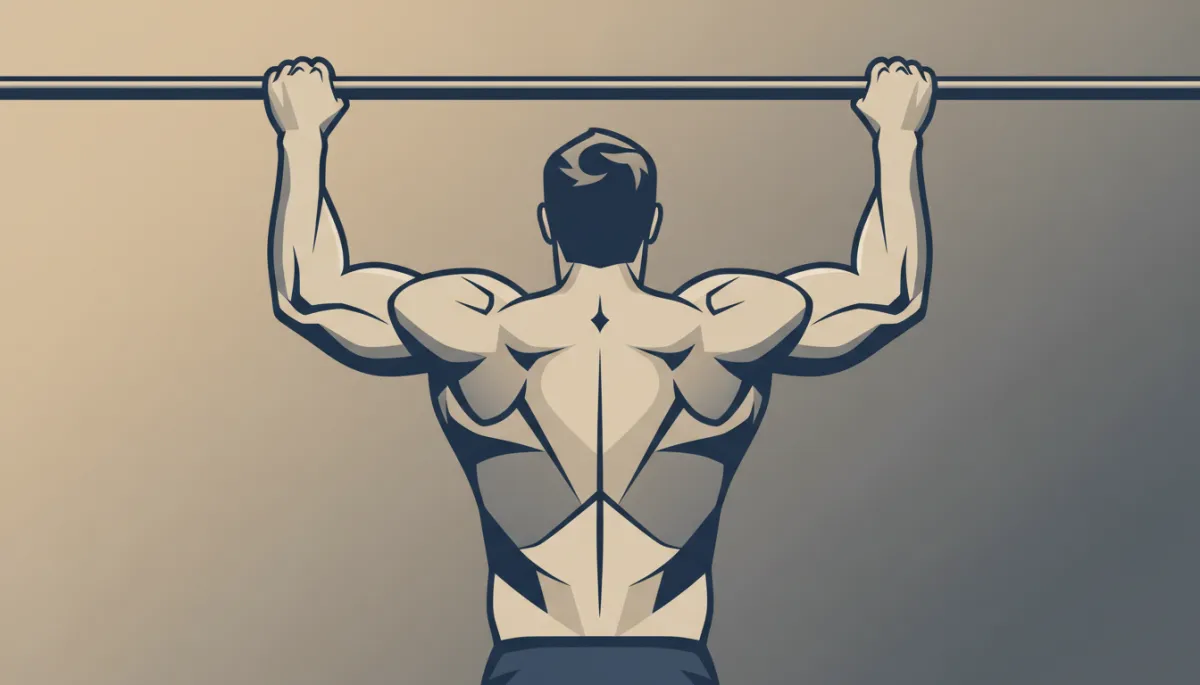
Controlled, full-range pull-ups build durable strength and shoulder resilience.
Strength Programming: Architecting Your Push-Up and Pull-Up System
Now that the “functions” (movements) are defined, let’s design the program. Push-ups and pull-ups respond best to a blend of volume, frequency, and quality reps—not occasional all‑out burnout sets. Here are two elite programming methods that map nicely to how engineers think: Greasing the Groove and ladder training.
Greasing the Groove (GTG): Frequent, Submaximal Practice
Greasing the Groove is like running frequent, lightweight unit tests on your nervous system. You perform sets far below failure, multiple times per day, to improve neuromuscular efficiency—your ability to fire the right motor units with minimal fatigue.
Choose a rep number that’s ~40–60% of your max. If you can do 10 clean push-ups, your GTG set is 4–6 reps.
Spread 5–10 sets across the day, never reaching failure, always crisp form.
Here is a simple Python-style pseudo‑scheduler to think about GTG in “code” terms:
max_pushups = 10
gtg_rep_target = int(max_pushups * 0.5)  # 50% of max
sessions_per_day = 6

for session in range(1, sessions_per_day + 1):
    print(f"Session {session}: do {gtg_rep_target} perfect push-ups")
    # Rest at least 45-60 minutes between sessions
You can apply the same logic to pull-ups, even if it’s just 1–2 reps per session. Over weeks, your “baseline” strength quietly climbs.
Ladder Training: Structured Volume Without Sloppy Reps
Ladder training is like a simple, predictable for‑loop for reps: you start with a low number, add a little each set, then drop back down and run the loop again. This lets you accumulate a lot of clean work while staying well away from failure.
Here’s a clear example of a push-up ladder if your max set is around 12–15 reps:
Ladder 1: Do 3 reps, rest, then 4 reps, rest, then 5 reps, rest a bit longer
After you finish 3–4–5, go back to 3 and repeat for 2–4 total ladders
Accessory Work: Fixing Bottlenecks in the System
Just like profiling reveals hot spots in your code, your body has weak links that cap your push-ups and pull-ups. Targeted accessory work lets you patch those bottlenecks.
Accessory Work for Push-Ups
Planks and side planks: Build core stability so your torso stays rigid. 3 sets of 20–40 seconds each.
Paused push-ups: 1–2 second pause at the bottom to eliminate bounce and build strength where you’re weakest.
Ring or dumbbell rows: Balance pushing with horizontal pulling to keep shoulders healthy.
Accessory Work for Pull-Ups
Inverted rows: Scalable horizontal pulling that builds back and grip. 3–4 sets of 6–12 reps.
Face pulls or band pull-aparts: Strengthen rear delts and upper back to support your shoulders.
Farmer’s carries: Build grip and overall tension control—carry heavy dumbbells for distance or time.
Fitness Recovery: Let the System Rebuild Between Deploys
Strength gains don’t happen while you’re grinding out reps; they happen while you recover. Without solid fitness recovery habits, even the best program will stall like a server under constant load with no downtime.
Sleep: Aim for 7–9 hours. This is when your nervous system consolidates motor patterns and your muscles repair.
Active recovery: Easy walks, light mobility work, and gentle stretching on non‑intense days keep blood flowing without adding fatigue.
Deloads: Every 4–6 weeks, reduce volume or intensity for 5–7 days. Think of it as garbage collection for accumulated fatigue.
💡 Pro Tip: Persistent form breakdown, nagging joint pain, or dropping performance are “error logs” from your body. Back off volume, prioritize sleep and nutrition, then ramp up again.
Neuromuscular Efficiency: Optimizing Your “Runtime”
Neuromuscular efficiency is essentially how well your brain and nervous system talk to your muscles. Better efficiency means more force with the same muscle mass—like optimizing algorithms instead of just throwing more hardware at the problem.
Frequent practice (GTG): Sends repeated, low‑fatigue signals, improving coordination and motor unit recruitment.
Slow negatives: Controlled eccentrics teach your nervous system to own the full range of motion.
Consistency: Training 4–6 days per week with smart volume beats occasional hero workouts every time.
Putting It All Together: A Sample Weekly Blueprint
Here’s how you might structure a week focused on push-ups and pull-ups, assuming intermediate level:
Mon – Push focus: Push-up ladders + core accessory work
Tue – Pull focus: Pull-up ladders + rows and face pulls
Wed – Active recovery: Walking, mobility, light band work
Thu – Push GTG: Submax push-up sets throughout the day
Fri – Pull GTG: Submax pull-up singles/doubles across the day
Sat – Mixed: Easier push and pull variations, technique focus
Sun – Rest: Full recovery, light walking, good food, good sleep
Conclusion: Ship Small, Ship Often, and Respect the Process
Mastering push-ups and pull-ups isn’t about one heroic workout; it’s about weeks and months of clean reps, smart strength programming, and disciplined recovery strategies. Treat your training like a long‑lived production system: monitor feedback, fix form bugs early, scale volume carefully, and schedule regular maintenance.
Start with your current level, choose appropriate effective progressions, implement Greasing the Groove or ladder training, support it with targeted accessory work, and protect your gains with intelligent recovery. Do that consistently, and you’ll be shocked at how fast your reps—and your confidence—skyrocket.
